We began planning in 2025. We anticipate construction will begin in 2031 with an in-service date by the end of 2033.
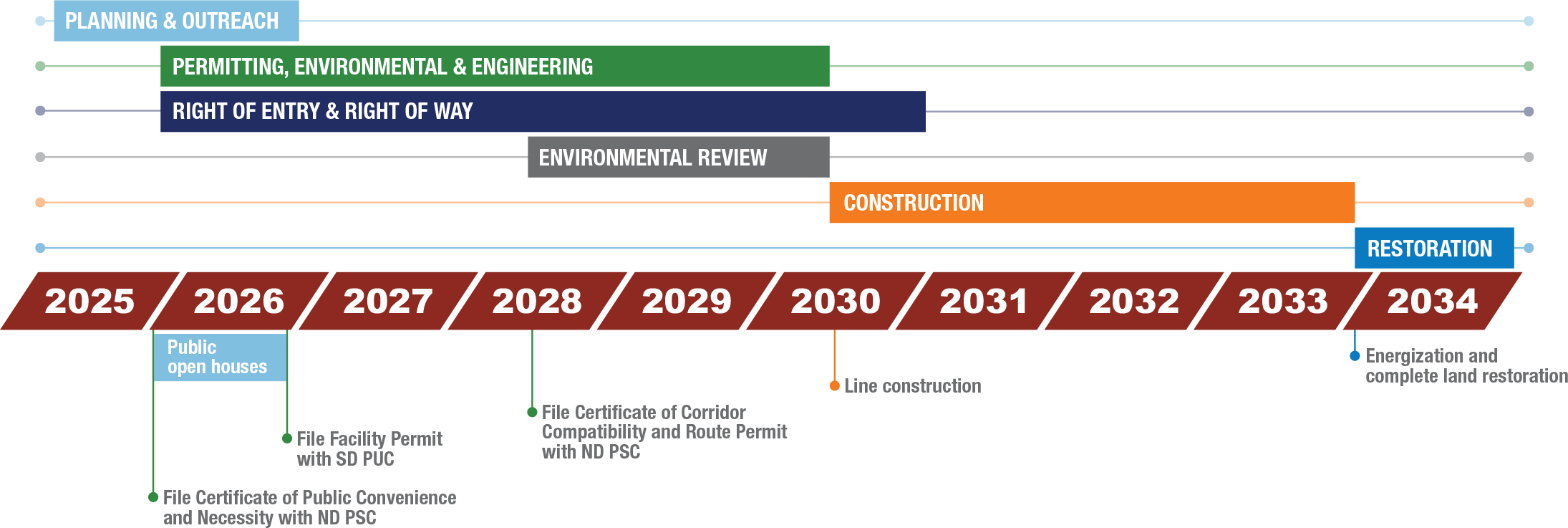
* Schedule is subject to change
The Big Stone South to Hankinson to Bison (BSSHB) 345-kilovolt (kV) transmission line is one of five high-priority projects identified in the Joint Targeted Interconnection Queue (JTIQ) portfolio, jointly developed by the Midcontinent Independent System Operator (MISO) and the Southwest Power Pool (SPP). This project is designed to improve how two major power networks—MISO and SPP—work together at their connection points. It helps relieve pressure on transmission lines that are currently overloaded, making it easier to connect new power sources. Overall, it strengthens the electric system across the region, making it more reliable and better able to recover during emergencies or high-demand situations today and into the future.
The BSSHB line will connect substations near Big Stone City, SD; Hankinson, ND; and Mapleton, ND, and is co-owned by Otter Tail Power Company and Xcel Energy. The project is a direct response to the MISO Reliability Imperative, which calls for strategic infrastructure investments to support grid stability during extreme weather events and to accommodate the rapid growth of renewable energy resources.
MISO and SPP identified this project through the JTIQ study to meet customer needs and relieve congestion in the transmission system across areas of the MISO region, including North Dakota.
While not part of MISO’s Long-Range Transmission Plan (LRTP) Tranche 1, which includes 18 projects totaling $10.3 billion, the BSSHB line complements those efforts by addressing interregional needs and supporting renewable integration.
Otter Tail Power and Xcel Energy own the existing substations at both ends of the proposed route, making them well-positioned to develop this new transmission line serving North Dakota and the Upper Midwest.
The project will help to:
The project is also expected to undergo a full NEPA Environmental Assessment (EA), NHPA Section 106 review, and Endangered Species Act Section 7 consultation, reflecting its scale and environmental sensitivity.
Yes. All North Dakota and South Dakota customers, regardless of their electric service provider, rely on a common transmission system to deliver their electricity needs. This common transmission system is interconnected to allow for the reliable and efficient delivery of electricity. Otter Tail Power has existing transmission lines that are interconnected with Western Area Power Administration and Central Power Electric Cooperative near Big Stone and Hankinson while Xcel Energy has transmission lines that are interconnected with NorthWestern Energy near Fargo. This project will provide a new transmission path for electricity to flow to all customers in the event that other existing transmission lines are unavailable.
The typical structure will be an approximately 150-foot-high, single pole made of self-weathering steel with single-circuit capability, meaning it can support a second set of conductors. Each structure will have a diameter ranging from 7 to 14 feet, and the permanent land impact will be less than 2 acres. While this is the proposed design, the structure type may vary. We’ll continue to share more details as they become available.
Underground 345-kV transmission lines haven’t been used in our area for a number of reasons. Some of the main challenges associated with underground 345-kV transmission lines are as follows:
In short, underground 345-kV lines have significantly greater impacts on landowners, resulting in extended outage times and much higher costs than overhead transmission lines.
We’re building the BSSHB transmission line to make the power grid stronger and more reliable across North Dakota, South Dakota, and the Upper Midwest. It helps ease congestion so electricity can move more freely, especially during high demand or emergencies. Down the road, new energy sources, like wind farms, might connect to it, but they’d go through their own approval process first.
We’ll undergo a consultation process with federal and state agencies to avoid and minimize adverse impacts to sensitive species within the right of way.
We’ll obtain environmental permitting and approvals from appropriate federal, state, and local agencies once we’ve identified a final route and prior to construction. We’ll carefully track, apply, and ensure all permits are followed.
We’ll also coordinate construction activities with local government agencies, jurisdictions, and other stakeholders.
Right of way is a portion of land needed for the construction, operation, and maintenance of the transmission line. Typically, a width of 150 feet is needed for a 345-kV transmission line. Right of way is typically secured through negotiation and acquisition of an easement agreement.
To assess potential routes and conduct the necessary environmental, engineering, and geologic studies/surveys, right-of-way agents will work with landowners and residents to acquire a temporary right-of-entry agreement, which allows us to access a property for things like surveys, soil testing, and environmental studies. This agreement does not give permission for an easement nor for construction.
An easement agreement provides the rights for Otter Tail Power Company and Xcel Energy to access, construct, operate, and maintain transmission lines and associated facilities (e.g., structures, wires) on your property.
We value landowner and resident input and will take all feedback and input to the project team for evaluation. Example feedback may include soil type or condition, known cultural areas, quarries, cemeteries, private airstrips, homestead locations, or other critical siting criteria.
We anticipate the North Dakota Public Service Commission and the South Dakota Public Utilities Commission will issue siting certificates in 2027. Other environmental permits can take up to a year depending on the permit’s specific conditions. Required permits will be applied for and granted before the start of construction.
The best way to get involved is to visit this website or send us an email at connect@BigStoneSouthtoHankinsontoBison.com with questions, comments, or concerns. Landowners and residents within the route corridor will receive information throughout project development.
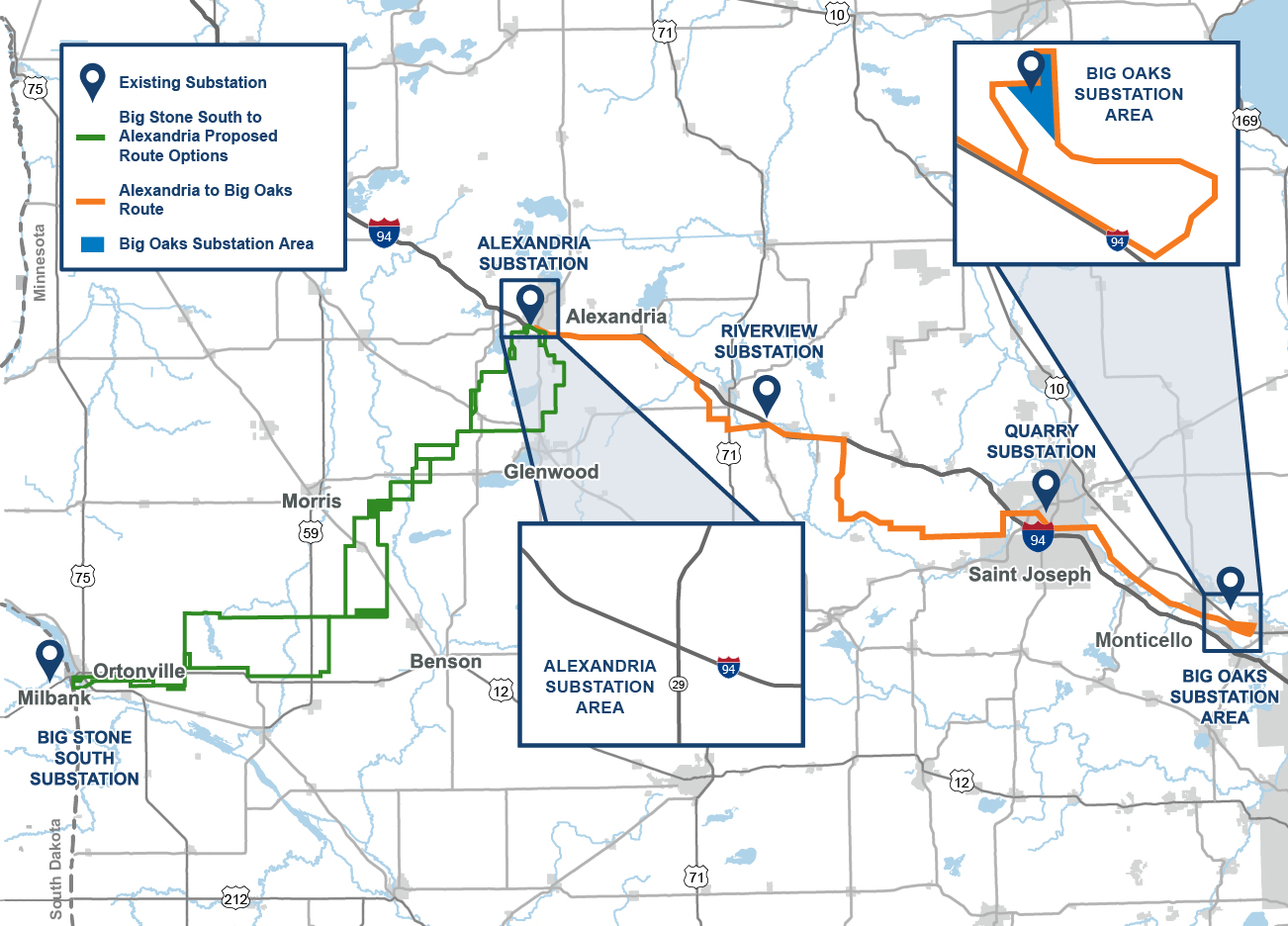
This Big Stone South to Alexandria (BSSA) project is the western segment of a larger project called Big Stone South to Alexandria to Big Oaks.
Alexandria-Big Oaks
The eastern segment of the project, identified as the Alexandria to Big Oaks (ABO) project, is being developed by Otter Tail Power Company, Missouri River Energy Services, Great River Energy, Minnesota Power, and Xcel Energy and will add a new transmission circuit to the existing 345-kV transmission structures that run mainly along Interstate 94. The ABO segment will connect to the existing substation near Alexandria, Minnesota and the proposed Big Oaks substation near Becker, Minnesota. Along with the Certificate of Need, the Minnesota Public Utilities Commission also granted the Route Permit for this segment on October 3, 2024.
 Approved October 2024 Approved October 2024
Learn more about the Alexandria to Big Oaks Transmission project.